








Allied Health Clinician Hub
Allied health has a short career ladder, and growing usually means either a heavier caseload with a slightly better title, or going out on your own. We're building a clinician network so it doesn't have to mean either, and everything here is meant to help you work out whether that's for you. Employed and weighing up working for yourself? Start with the Going Independent Guide. And whoever you work for, the AI Leveraged Practice Guide will help you enhance your clinical practice.


The Going Independent Guide
If you've been turning over the idea of working for yourself, the thing that stops most people isn't the clinical work. It's not knowing what has to be in place, what the money does in the first year, and what you'd be taking on that isn't therapy. This guide covers all of that, in roughly the order you'd need it, and ends with a checklist to work through before your first day.
What you have to set up, in order
The ABN, tax and GST, the insurances, where you stand on workers compensation, and what happens to your super, with a checklist of what has to be in place before you see your first client.
How the money behaves
What changes when income arrives session by session rather than fortnightly, and how to plan for tax, leave and the quiet weeks.
What stays yours to do
The parts of running a practice you'd be taking on yourself, the parts you don't have to, and the questions to ask any provider, including us, before you sign anything.
Not doing it on your own
The supervision and peer contact worth lining up before you go, so independent doesn't turn into isolated.
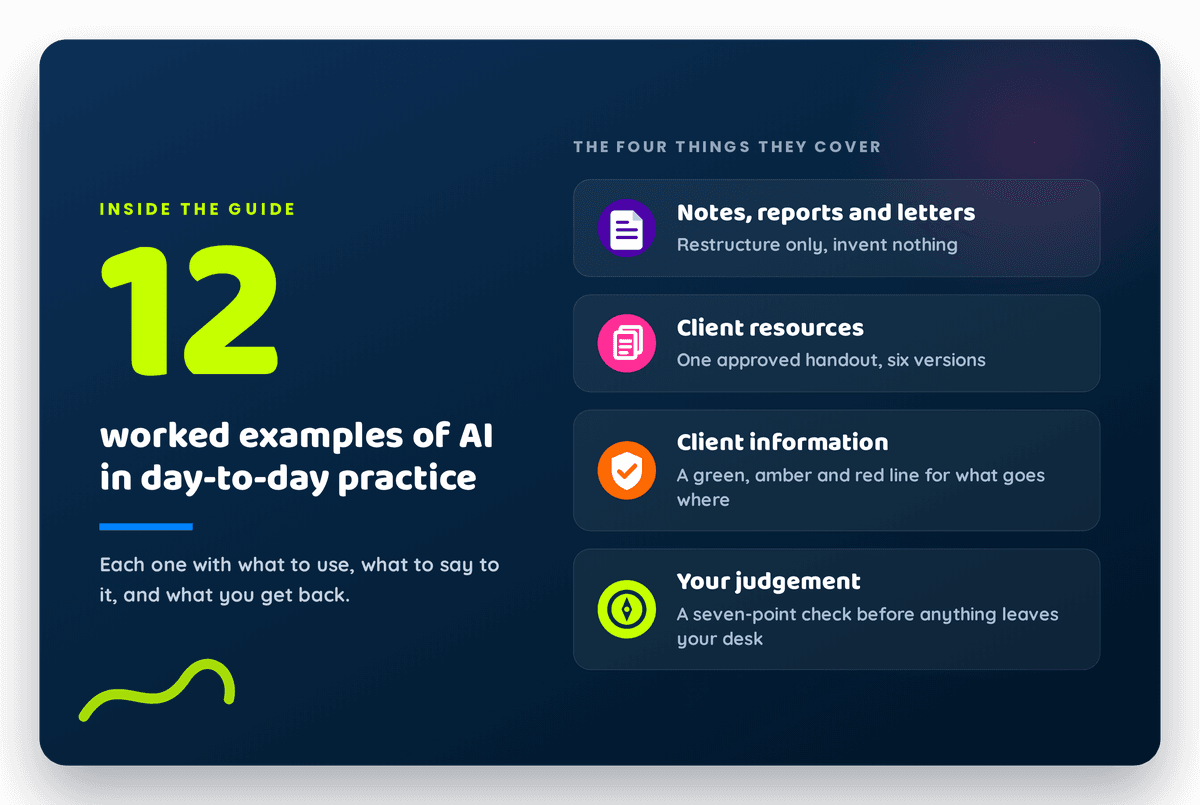
Learn how to leverage your work with AI
Employed or working for yourself, the problem with the week is the same. Notes and reports eat the spare hours you have, so the resources you'd like to make for clients get pushed aside, and the upskilling and PD you meant to do this year slides into next.
This guide is about more than getting some of that time back. It's about using AI to do the things you've never had time for, like turning one handout into versions every client can actually use. It walks through the ways clinicians are using AI to strengthen their practice and deliver a better client experience — which tools to use, what to prompt, and what you'll actually get back. Plus, a plain English rule for handling client information, so you know what's safe to put in.
A new way to progress your career in allied health
It's a career built on your skills and knowledge, not on waiting for the seat above you to come free. You subcontract with us, so you decide your days, your caseload and how you practise, and referrals, billing and admin are handled for you. Next, and being built now, comes paid supervision and PD delivered by you, for other clinicians in our network.

Control over how you work
You set your own days, decide which clients you take, and can turn work down. There are no KPIs and no mandatory meetings beyond clinical governance. You're a contractor, so you hold your own insurances and you can bring people from your own business in.

Earnings set by you
What you earn isn't set by a pay band or decided once a year in a review. It follows the work you take on, so a fuller diary earns more and a lighter one earns less, and how full it is stays your decision. Nobody sets your hours or your targets, and nobody has to approve a change.

Less time on the work you didn't train for
We find the clients, raise the invoices and lodge the claims. Your diary, notes and reports live in JoeyAI, our own client management system, where AI helps you draft so you spend less time typing and more on the clinical thinking. The families you see are on BlueRocket Connect, where you share documents, messages, therapy programs with them in one place.
Some more helpful reading for Allied Health Clinicians

Thriving in Allied Health
Jun 30, 2026
The Groove: why good clinicians stop improving
Andrew Tobin / 4 min read

Thriving in Allied Health
Jun 25, 2026
Short-Term Winners: the three shifts coming for solo NDIS work
Andrew Tobin / 3 min read

Thriving in Allied Health
May 04, 2026
The Narrowing: why playing it safe is wearing you down
Andrew Tobin / 5 min read

NDIS Guides and Resources
Apr 15, 2026
Getting NDIS goals right: a practical guide for therapists and families
Steph Reeves / 5 min read